
Meet The Man Behind Anacortes’ Stunning Turquoise Collection
Tom Freeland grew up around the gorgeous blue hue of Turquoise in Kingman, Arizona. In his hometown, ranching and mining were the main ways people earned a living. He grew up seeing locals sell turquoise jewelry on rugs at parks and highway rest stops. Tom's father taught him and his siblings how to make jewelry. He also shared this skill with his children and a few others who took his classes.

Tom and Elisabeth Freeland own Elisabeth's Cottage By The Sea
It is in historic Downtown Anacortes, on the corner of Commercial and 7th Street.

We love stopping at what we call the "Rock Shop" in downtown Anacortes to see what Tom has on display.

He informed my family that turquoise is formed when acidic water comes into contact with copper. This combination of water and copper creates veins or nuggets of the stone.
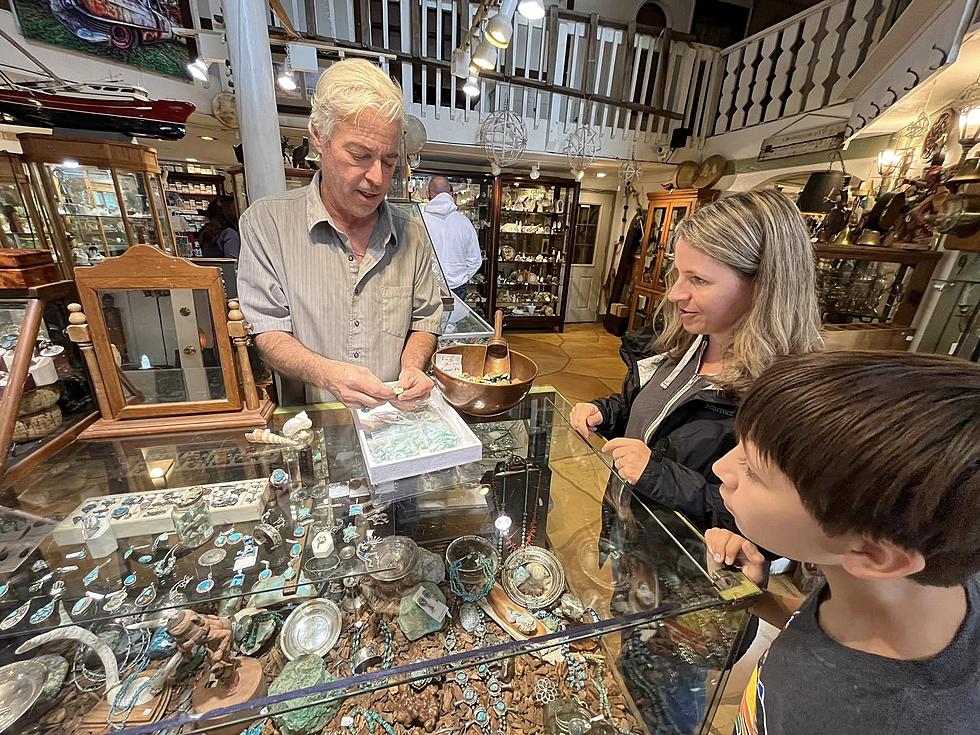
The process of mining for copper and separating the turquoise is quite time-consuming. With the decline of copper mining in America, only Mexico, Iran, Russia, and China remain as the primary producers of turquoise worldwide.
Between serving customers, Tom described to us the significant artifact on display

This carving was mined in the early 1960s and is now the largest carved piece of turquoise in America and the third largest in the world. It is proudly displayed with mirrors to highlight all its intricate details.
The stunning blue coloration of the piece was a major attraction at various rock exhibitions across the country until 1995. Now that its touring days are over, it can be admired at Tom's shop in downtown Anacortes.
It was shipped across the Pacific (twice, due to a mistake) and carved by five talented carvers in the Philippines.
Tom has a vast and expert knowledge of the Hualapai, Havasupai, and Mohave
He explained that Native Americans in the American Southwest were compelled to learn jewelry making from the Spanish conquistadors.

The Spaniards' quest for precious metals, which began in the early 1500s, led to the forced labor of native peoples in the American Southwest. They were compelled to work in a slave-driven industry, specifically in jewelry-making. This exquisite craftsmanship has been passed down through generations and has ultimately been learned by Tom. If you're interested, you can take a class to learn how to make jewelry yourself.

A Cookbook brought the Freelands to Anacortes
I asked Tom what brought him and his family to Anacortes.
A book called “Coastal and Cooking” featured recipes from restaurants on the West Coast.
The Freelands decided to visit the restaurants highlighted in the book, including two in Anacortes: “Calico Cupboard” and “Gere-a-Deli.” (Both are still in business today.) They liked the area so much that they kept coming back and eventually made Anacortes their home.

If you're looking for a turquoise beaded necklace, ring, earring, or belt, then take a road trip to Anacortes, Washington, and find Elisabeth’s Cottage By The Sea.

Elisabeth's Cottage By The Sea: 619 Commercial Ave, Anacortes, WA 98221
360-588-1890 - elisabethscottagebythesea.com

20 Photos That Perfectly Capture Small-Town Life in the 1970s
Gallery Credit: Stephen Lenz
45 Famous Alumni from Washington State High Schools
Gallery Credit: Reesha Cosby
More From KW3